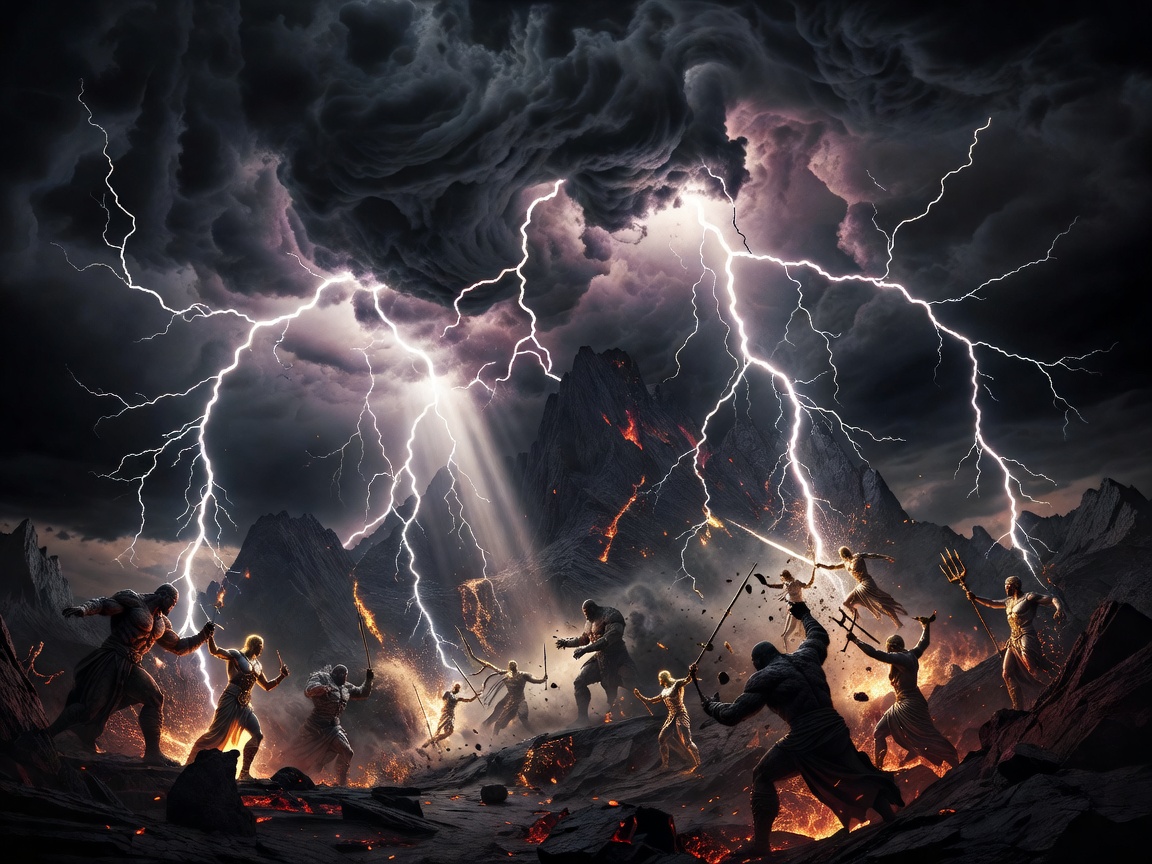
In classical Greek mythology, the Titanomachy (Greek: Τιτανομαχία) refers to the legendary ten-year series of battles fought in Thessaly between the Titans (the older generation of gods ruling from Mount Othrys) and the Olympians (the younger generation led by Zeus from Mount Olympus).
Origins of the Conflict
The root of the conflict stemmed from Cronus, who had overthrown his father Ouranos with a diamond sickle. Warned by a prophecy that one of his own children would depose him, Cronus swallowed each of his offspring at birth: Hestia, Demeter, Hera, Hades, and Poseidon.
Rhea, grieving for her lost children, hid her sixth child, Zeus, in a cave on Mount Ida in Crete, tricking Cronus into swallowing a stone wrapped in swaddling clothes. Upon reaching maturity, Zeus administered an emetic potion provided by Metis, forcing Cronus to disgorge his siblings intact.
The Turn of the Tide: Cyclopes & Hecatoncheires
For ten years the war raged without decisive victory for either faction. Following Gaia's advice, Zeus descended into the dark realm of Tartarus and liberated the Cyclopes and the hundred-handed giants known as the Hecatoncheires (Kottos, Briareus, and Gyges).
In gratitude, the Cyclopes forged Zeus his signature thunderbolts, granted Hades the Helm of Invisibility, and bestowed the trident upon Poseidon. Joining forces on the precipice of Mount Olympus, the combined Olympian forces launched a barrage of boulders and lightning that shattered Mount Othrys.
Consequences & Imprisonment
Defeated, Cronus and the male Titans (including Iapetus, Hyperion, and Coeus) were cast down into Tartarus, secured behind impenetrable bronze gates fashioned by Poseidon and guarded forever by the Hecatoncheires. Atlas was sentenced to support the celestial heavens on his shoulders for eternity.