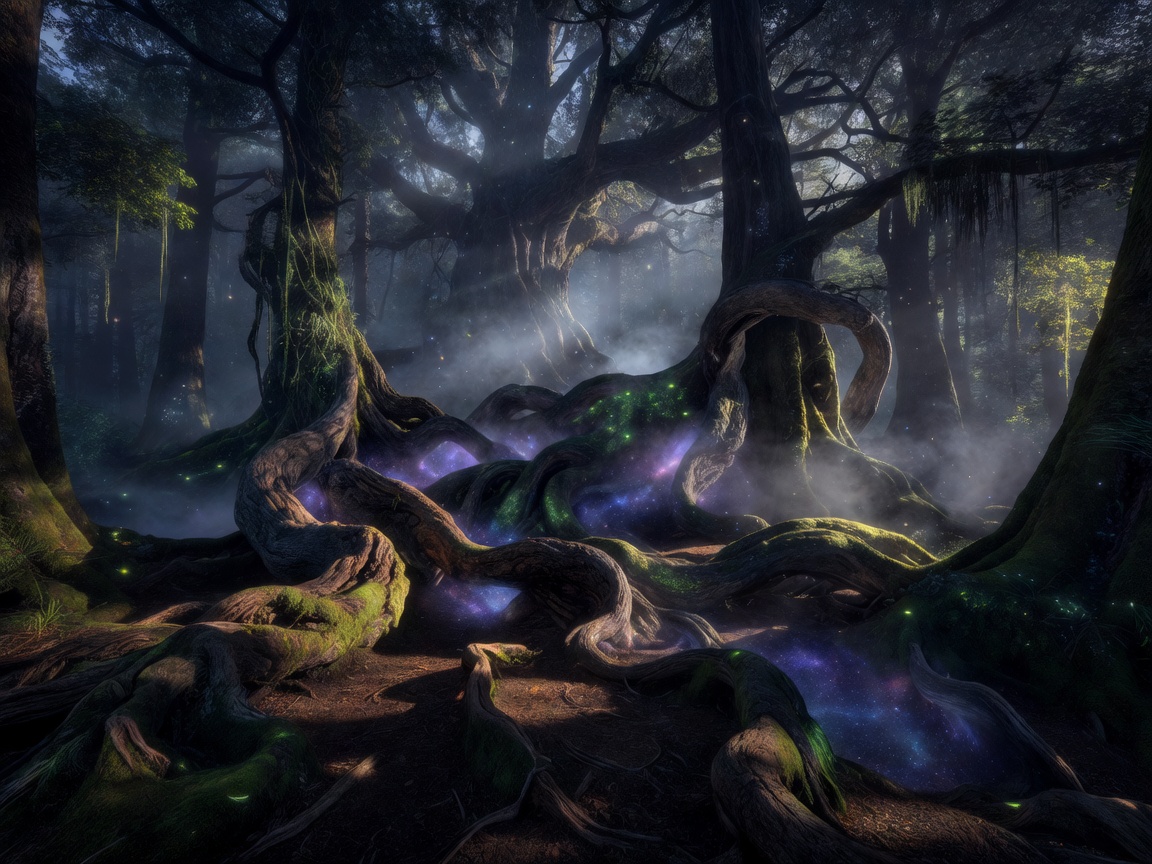
At the center of Old Norse cosmology stands Yggdrasil, an eternal evergreen ash tree whose roots and branches bind together the Nine Realms of creation. Mentioned in both the Poetic Edda and Prose Edda, Yggdrasil acts as the sacred pillar connecting celestial, terrestrial, and subterranean planes.
The Three Primary Roots
Yggdrasil’s weight is supported by three major roots, each extending into a distinct cosmic domain:
1. Urðarbrunnr (Well of Fate): Located in Asgard, where the Norns (Urðr, Verðandi, and Skuld) weave threads of destiny and tend the ash tree with sacred water.
2. Mímisbrunnr (Well of Mímir): Situated near the frost-giant realm, containing boundless wisdom where Odin sacrificed his right eye for a single drink.
3. Hvergelmir (Roaring Cauldron): Found in Niflheim, where the terrifying dragon Níðhöggr endlessly gnaws at the roots alongside venomous serpents.
Inhabitants of the World Ash
Yggdrasil is a dynamic living ecosystem inhabited by mythic entities: the eagle Veðrfölnir sits perched atop the highest bough, the squirrel Ratatoskr scurries up and down bearing insult messages between the eagle and Níðhöggr, and four stags (Dáinn, Dvalinn, Duneyrr, and Duraþrór) graze upon its tender shoots.
Cosmic Mapping in Modern GIS Data
When visualized in modern mythological cartography, Yggdrasil represents early Germanic vertical spatial stratification, reflecting seasonal changes, atmospheric phenomenon, and ancestral burial mound rituals across northern Europe.